Fish the Change: How to Read Productive Edges

A weedline, a bottom change, or a drop-off is not a guaranteed fishing spot. It is a place to make a better decision.
Start with what changed
Have you ever looked across a lake and wondered where to begin? There may be hundreds of yards of shoreline, acres of open water, and no obvious sign of a fish. Here's a simple way to narrow the search: look for a change.
A place where weeds end and open water begins is a change. So is the point where gravel gives way to mud, or a shallow flat drops into deeper water. Anglers call those boundaries edges or transitions. They are worth investigating because conditions on one side may be different from conditions on the other.
But here is the important part: an edge is not a magic stripe. Fish aren't required to be there. The value of the edge depends on what it offers at that particular time. Find the change, make a prediction, and let the fish tell you whether your prediction was right.
Why an edge can matter
Fish have to balance several needs at once. A patch of aquatic plants may offer small fish a place to hide and insects or other food to feed on. A predator may use nearby openings to search for prey or to ambush it. A drop-off may give fish access to more than one depth without traveling far. And a change from hard to soft bottom may support different kinds of food.
Fisheries research backs up the idea that habitat structure changes predator-prey behavior—but it also shows why there is no universal rule. In experiments with bass, pike, and their prey, how densely plants grew affected where predators stayed and how they hunted. Later work showed that predators and prey can actually prefer different amounts of plant cover [1, 2].
That is why I don't start by asking, 'Which lure should I tie on?' I start by asking, 'What is different here, and why might a fish use it?'
Three edges to learn to recognize


WEED EDGE — Look where healthy submerged vegetation meets open water, or where a thick bed breaks into pockets, lanes, and scattered clumps. For bass and panfish, cover, food, and escape routes may overlap here. Don't assume the fish are right on the outer edge; test the pockets, the inside edge, and a short distance off the weeds.
BOTTOM CHANGE — Rocks and gravel have crevices, while softer bottoms may hold different invertebrates. A boundary between them gives you two habitat types to investigate in one small area. A jig or other bottom-contact lure can help you feel the difference: a sharper tap over rock, a softer or more dragging feel over mud. Feel is only a clue; it takes practice and can be affected by line, lure, and current.
DEPTH BREAK — The top of a drop-off, its slope, and the bottom of the drop may all be useful at different times. A point, submerged channel edge, or shoreline that steepens can be worth a few careful casts. Depth matters because light, temperature, oxygen, cover, and forage may change with it. None of those conditions is guaranteed to be ideal simply because the bottom falls away.
Other changes count, too. Shade meeting sunlight, a current seam, or clearer water meeting stained water can provide clues. I begin with the most obvious transitions and work outward from there. The Missouri Department of Conservation also identifies weedlines, drop-offs, hard-to-soft bottom changes, and current breaks as places worth examining [3].
You can find edges without a fish finder
Start by studying the shoreline. A point of land often continues under the water. A steep rocky bank may hint at deeper water close by. An opening in shoreline weeds may continue below the surface. A row of emergent vegetation can show where the bottom, water depth, or habitat changes.
Watch your line and what your lure tells you. If it begins touching plants on one retrieve but comes back clean on a cast a few feet farther out, you've learned something about the weed edge. If your jig changes from crisp bottom taps to soft contact, you may have crossed a change in the bottom. If a sinking lure takes longer to reach bottom on one cast, the area may be deeper; remember that wind, current, and line angle also affect the count.
You don't need to know the exact depth of every square foot. You need enough information to make the next cast mean something.
The three-cast edge test
Before changing lures, make a short, deliberate survey. Keep your presentation similar so you can compare what each cast tells you.
CAST ONE: Parallel. Work along the edge, staying close to the same depth or cover line for as much of the retrieve as practical. This keeps the lure in one kind of habitat longer.
CAST TWO: Diagonal. Bring the lure across the edge at an angle. This can show whether fish respond as the lure enters, leaves, or travels beside the change.
CAST THREE: Across. Cover both sides of the edge, or the top and base of a break, using a presentation that reaches the depth safely and effectively.
Three casts are a starting sample, not a verdict. If you feel a strike, bump, vegetation, or bottom change, repeat the most informative line and adjust just one thing—depth, speed, or angle—before moving. If you learn nothing after a reasonable test, try a different edge or a different set of conditions. From shore, make only the angles your access and safety allow; from a boat, maintain safe positioning and avoid disturbing other anglers.
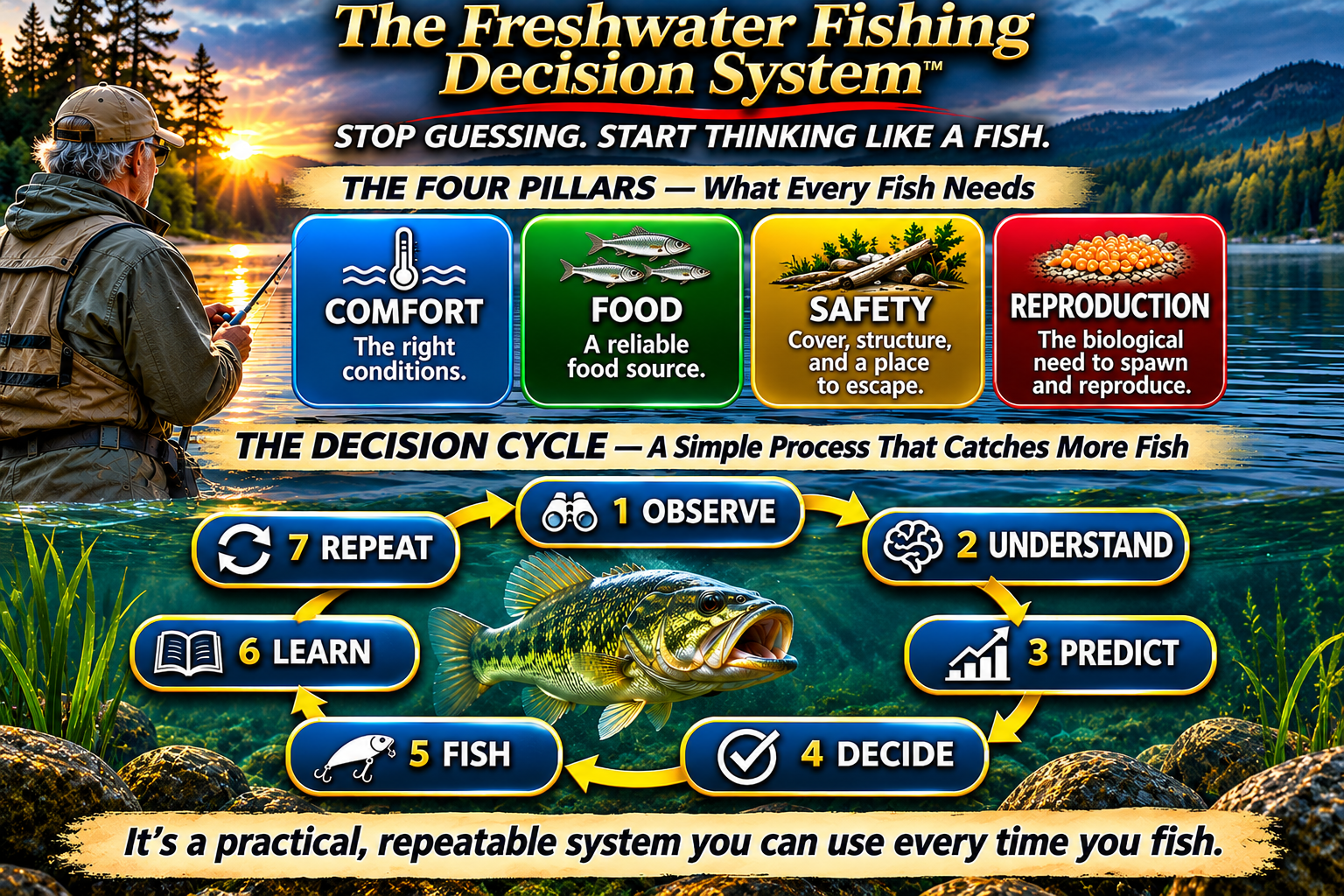
Let the Four Pillars judge the edge
COMFORT (blue): Is the temperature, oxygen, current, and light at that depth suitable for the species you're after? An attractive drop-off is not much use if the water in that layer is unsuitable.
FOOD (green): Do you see or suspect forage—baitfish, insects, crayfish, or other prey—using either side of the transition? The food source may be inside the cover, just outside, or moving along it.
SAFETY (yellow): Can small fish use plants, rocks, deeper water, or other cover to reduce risk? Can larger fish approach prey without exposing themselves unnecessarily?
REPRODUCTION (red): Is the season and species one for which spawning habitat, staging routes, or post-spawn recovery might influence where fish are? Reproduction is a powerful need at some times and largely irrelevant to the day's location at others.
A weed edge that satisfies two or three needs today may deserve more attention than a beautiful drop-off with no suitable temperature or available forage. The Four Pillars help you decide which changes are worth your time.
Run the Decision Cycle, not a guessing contest
OBSERVE: Notice the weedline, bottom change, or drop-off, and any signs of food or fish.
UNDERSTAND: Ask which of the Four Pillars this edge might provide at this time.
PREDICT: Choose the side, depth, and travel path where a fish seems most likely to use it.
DECIDE: Select one lure or bait and a presentation that can reach and remain in that zone.
FISH: Make controlled casts along, across, and through the change.
LEARN: Record the bite, follow, missed strike, bottom feel—or the lack of a response.
REPEAT: Keep what worked, change one thing that didn't, and apply that lesson to the next edge.
One outing, one useful lesson
Here's an exercise for your next trip. Pick two reachable transitions rather than working aimlessly around the whole lake. At each one, make a few casts that test the edge, then compare where the lure ran, which depth you reached, and what the fish did. Keep your setup the same long enough to learn something.
If the fish strike only as the jig leaves the weeds, that's a clue about where and how they were willing to attack. If they take the lure partway down the slope, that's a depth clue. And if neither edge produces, you've still eliminated two predictions and can look for another combination of Comfort, Food, Safety, and Reproduction.
FISHING TRUTH: A good-looking spot is a starting hypothesis. The fish get the final vote.
DECISION RULE: Find a change. Choose one reason fish might use it. Test both sides at the right depth. Let the result guide your next decision.
Before you leave, protect the habitat you came to fish. Avoid damaging sensitive vegetation or spawning areas, respect shoreline access, and follow local regulations.
STOP GUESSING. START THINKING LIKE A FISH.
References
1. Savino & Stein (1989), effects of plant density on fish predators and prey, U.S. Geological Survey: https://www.usgs.gov/publications/behavioural-interaction-between-fish-predators-and-their-prey-effects-plant-density
2. Coppola et al. (2021), predator-prey habitat selection in submerged plants, U.S. Geological Survey: https://pubs.usgs.gov/publication/70229070
3. Missouri Department of Conservation, Fish Habits and Habitat: Structure and Edges: https://mdc.mo.gov/fishing/get-started-fishing/fish-habits-habitat


Comments